The Myth of Personalised TV


Since circa 2012 we have been looking at ‘Personalisation’ of content for each viewer of media and entertainment – Online – Sports – Music – and ultimately Television – “Because you watched that you might like this” … It is now 2025 and I ask, “Has personalisation been realised?,” “Does my Television know who I am and what I like?” The document linked below explores this aspect and while it may ruffle a few feathers of those in this segment, I truly believe that we have spent a small fortune on technology getting us not very far. The human aspect and nuances of ‘in the mood for’ as well as the complexity of privacy are just too complex for TV systems to work effectively. In order to understand 100s of millions of people content preferences and desires at any given time, then serve them up accurately may well be a pipe dream. For you to judge and for you to agree or disagree. Here is the ‘book/pamphlet’ called the ‘The Myth of Personalised TV – 2025.’

Thank you

Anthony

TV Fragmentation Reigns


Some years ago, it was plainly evident to anyone who has any common sense that the world of media and entertainment content would fragment. In the transition from broadcast to online, the opportunity seemed clear to content owners that a global reach for their content was as simple as putting it all online and direct-to-the-consumer. However, the business, at the time, just wasn’t ready for this and quite frankly still isn’t prepared to allow that to happen ‘carte-blanche.”

I wrote on this topic in 2009 and an update in 2012. It is now 2020, and content rights, geo-blocking, and market dynamics all inhibit the passage of content from broadcast to over the Internet worldwide. Like websites, there is a myriad of Apps all purporting to offer the same content, but in reality they do not. Still, the truth is that national, regional, and content licensing remains an industry sticking point – there is not going to be a central repository of content that we can dip in and out of.

Sports are the most affected in recent years and coming up against the complexity of the industry. Pay-TV has been able to keep sports as one of the mainstays of its premium tier offers and, in some instances, they offer less popular sports (lower tiers), often at odd times of the day i.e. not prime time. This causes a dilemma for these sports as they sign-up to broadcast deals (often behind pay-walls), limiting their rights to show the games on other platforms such as OTT in particular. Happy to be considered good enough for broadcast TV, but then caught in the mouth of the lion.

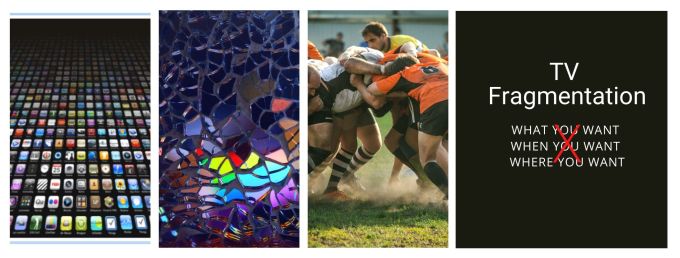
The industry adage of ‘What I Want – When I Want – Where I Want’ still cannot be satisfied. Content owners have fragmented or gone vertical, leaving the consumer foraging for certain content across all manner of locations. The costs are mounting up and the consumer is becoming disheartened.

On a recent weekend, I wanted to watch Wales against Scotland and saw that it was not on my NBC Sports Gold app. I quickly went hunting and could not find the match on any platform that I was subscribed to. How frustrating! Very, very disappointing! Even the pirate sites that I found were asking for money (naturally) so its not an option.

At home I have a Cox subscription (it wasn’t being shown on any channel) … I also have a NBC Sports Gold rugby pass but it didn’t show it, Netflix – don’t do sport – Hulu – don’t do sport – HBO Max – don’t do sport … then there is DAZN purported to be the Netflix of sports – don’t do International rugby in the USA – Rugby Pass – geo-blocked … #WTF what’s the point? I am feeling hard done by and frustrated. I am tempted towards piracy – it is cheap and is available. Doesn’t the industry understand that they have an issue?

I’ll keep up my hopes of getting – What I Want -When I Want – Where I Want, but I don’t think that will be for quite some time, if ever!


TV Middleware – The long and winding road.


cogs

The digital TV middleware/OS market has been in full and continued development since the early 1990s. For the last 28 years, the TV receiver software (digital) has remained a fundamental building block or foundation stone of Advanced Television Services. Middleware/OS continues to evoke strong opinion and is a much-maligned. Despite this, it remains firmly ensconced in the digital TV business, forming part of the DNA that is interactive digital television, whether we like it or not.

BTW: There is very little that has not already been tried in the TV domain and not a lot of ‘new’ inventions when it comes to the world of TV.

e.g. Voice made its debut back in the early 2000s. We laughed at it back then; now it is a must-have technology in a very packed content world. Gesture control came and went and now, according to many TV experts, it’s going to be micro-gesture going forward. There was face recognition capability, widgets, and Social Media on TV and good old 3D! Well, let’s not go there …

Along the digital TV software journey, there is one constant = the infamous middleware/OS, and we have seen many solutions come and go, with the resurrection of some technology blocks that were once tried, disliked and considered not fit for purpose. These solutions have a new lease on life now that the STB/CPE products have much faster chipsets and huge memory capability. Not to mention that the transmission medium, which has developed at an equally impressive rate allowing for the offsetting of services in a client-server arrangement. Flash, HTML, JavaScript, and Java are examples of once used, refused only to see a re-introduction into the TV landscape. Back in the 90s, a company called Liberate (part of Oracle) (Liberate Technologies: Taking Strange to New Levels, 2009) had championed an early web-like solution, only to see very expensive, clunky, slow, STBs that led to extremely dissatisfied customers. Flash for the STB/CPE came and went. We had Java as part of Open Standard initiatives right across the TV landscape but back then it didn’t manage to make enough headway to stick. Java is once again back under the umbrella of Android, with their 4th or 5th time out of the middleware/OS starting blocks. The finish line is a long way off before there can be a single winner declared. This is truly a long and winding road.

Here is a long and incomplete list:

  • powerTV
  • OpenTV Core
  • MediaHighway
  • MicrosoftTV
  • Liberate
  • NDS core
  • MHEG
  • DAVIC (MHEG + Java)
  • MHP
  • OCAP
  • ACAP
  • MHP-GEM
  • ARIB B23
  • JavaTV
  • EBIF
  • GINGA-J
  • ON-RAMP to OCAP
  • Various flavours of Linux Distee
  1. OpenTV 5
  2. Frog by Wyplay
  3. Espial
  4. Alticast
  • Boxee TV
  • Horizon TV
  • InView
  • Oregan
  • WebOS
  • Tizen
  • iOS
  • Tivo
  • FireTV
  • Roku Brightscript
  • Google TV
  • Android AOSP
  • RDK
  • Android TV
  • ATSC3.0

So what else do we have in store for the STB/CPE as we blend Broadcast & Internet and look to create new and exciting services for a future generation? Who knows where the digital TV middleware/OS industry will finally settle.

New Book Now Available


Social Media Psychobabble – Stop Feeding the Beast is now available to order.

It can be bought through www.socialmediapsychobabble.com, which takes you to Amazon UK, Germany and USA.


PLEASE STOP PREDICTING THE DEMISE OF TRADITIONAL TV – IT’S BORING!


tvoldHere we go again! … Old TV versus New TV … Because you can open a TV channel on the Internet you can make money and therefore traditional TV is dead!  Since the AWS announcement certain ‘TV Experts’ have declared it so.  There are so few people in the world that can predict the future (i.e. ZERO) but there are people who can look at the past and the present and then extrapolate ideas of how things MIGHT work out: Seldom are any of them right.
By the way, notwithstanding the progress of video content over the Internet (OTT) there is an abundance of closures:

Fullscreen, Afrostream, Sportflix, Go90, Vessel, SeeSo, Redbox Instant, Xbox Entertainment Studios, Samsung Video & Media Hub, Stickam, Flickr Video, Metacafe, Justin.tv, Veoh, Blip.tv, vidiLife

Can you make money in OTT Shelly Palmer? – You make it sound so easy … (Why not try starting a video business and see how it goes).  It’s OK here is someone who has done it: This is a real OTT story Afrostream Closes – This is an amazing insight into the $$$$$$$ that are needed to survive and it openly describes the full impact of what it takes.

If  a 2% Churn rate is an issue for a Pay-TV provider why is the following statistic not an issue to the on-line video businesses?

“OTT Churn Rates Pass 50%”

We do not know how this industry will pan out. Fragmentation, Churn, Net Neutrality, Content Investment and the Pay-TV businesses not just rolling over and dying is some, but not all of the things to be considered when predicting the future of TV … And touting Statistics does not make you an expert…

The rigours of life and television … is still the same as it ever was.


Let’s open with a quote from Colin Dixon’s (of NScreenMedia) well written article on TV viewing habits, where we are debating (in the comments) the merits of the small screen in the mix of viewing devices.  We all have our opinions on that.

On-demand, live, and online viewing peak at the same time

What is interesting and to me, and hardly a revelation, is that people all watch TV when they can or want to. It is generally around the same time, in the evening after work, after homework and after the kids bedtime (if you have some of course) – This is called PRIME TIME VIEWING – i.e. it is when you are most available to consume content uninterupted. So no matter where it comes from, Prime Time content is still Prime Time content.  The TV industry and ‘wannabee TV operators’ (i.e. Facebook, Twitter, Snapchat et al) think they can all have you as their sole Prime Time viewer…

I have covered this time and time again – Despite all of the content that is available, on all of the systems we have, we all have a limited window of time that we can offer this particular entertainment medium.  Most stats reveal that it is the same window of opportunity on a per country basis, which is enough for the news, a couple of TV shows and/or a film.  There is simply too much TV available today to fill everyone’s 15 years-of-lifetime-TV-viewing (yes we spend around 15 years of our lives in front of the TV).

Nothing new: Rebecca Lake a financial journalist from North Carolina – published this in 2015

What’s the most popular time of day for watching TV?
Prime time is when the majority of viewers are tuning in, with nearly 2 hours of daily TV watching taking place between 8 and 10 pm. Daytime TV airing between 11 am and 4 pm comes in second, with people watching about 1 hour and 40 minutes on average.

However when Robots take over our jobs we will have more time to watch much, much more .

A Short Play Called ‘The Death of TV’


Setting the scene: The evening light is dimming.  It’s 8pm and the children are snuggled down in bed and the husband says,  “Dinner is almost ready honey, can you find us something to watch on TV?” …


Picking up the remote the wife switches on the TV …

“I don’t know darling!” “Why not honey?”  “Because there is only a bunch of icons on the TV and I cannot see any TV shows, that guide thingy we used to have, it’s gone darling!”  “Gone! Why would they do that honey, it was very convenient.”  “I heard that you are supposed to know what you want to watch darling, you just ask for it now.”  “Really honey, OK!”  “Are there more programmes like that documentary on South Africa we saw the other night?”  “Maybe darling, what was the programme called?” … “Ermm, what channel was it on?”  “I cannot remember darling.” “Neither can I honey.” “Oh!” “Now what shall we do?” … “Ask the TV honey its got that voice thingy activated.”  …

Wife fiddles with remote control – pushes button …

“TV,  Can you find me any travel programmes about South Africa, but not about South Africa as we have seen that, what about somewhere else please.”

Screen icon turns … searching … searching … searching … TV replies

“Can you be more specific, I have 24,000 programmes on South Africa and 30,000 programmes not on South Africa and I have several shows called Somewhere Else.”  “I have them in English, Greek, Spanish, Arabic, French, Portuguese, Polish, German and 25 other languages, what do you want me to do?”

8.45pm: “Have you found anything honey?” “No darling, I’m afraid not … its not that instant anymore.”  “Shall I put the radio on honey?”

The End.

TV Viewing HAS NOT Changed – The Gap Filling Has!


We have yet another set of statistics that declare the living room TV Viewing habits are changing.  Let us look at this from another perspective:  I would put it to you that it is not TV Viewing that has changed it is human habits that arhave changed due to the advent of ‘New Technologies’.  If you were to take away the smart-phones and tablets from a TV centric family (as I have done at home recently) you will see that the TV viewing on the BIG Screen once again takes principle place.  Not book-reading, or board-game-playing but TV, and it quickly becomes a fight for the remote control with unhappy, sulky members of the family who are not interested in what the others are viewing….however we noticed that slowly but surely a migration back to sitting as a group with sharing-as-a-group takes place and an agreement to share what is on the TV, as it did in the time before these other access devices entrered the fray.  As a family we searched for common-content that all the family could get a little something from, be it a documentary, a film or even a cartoon that pleased everyone .  We became part of our children’s TV world and they ours, once again.  We also adhered to the ratings and respected the different viewing options based on quality of content – NO MORE VIOLENT, SEX RIDDLED,  TRASHY OR STOOPID content.  It was a pleasant and fulfilling exercise.  During the ads we went to the loo, talked and did what we always used to do during the Ad breaks – Watched some Ads and not others… (BTW Ads do not require ‘viewing only’ for them to have effect – the audio part subcontiously enters the brain even if you are not watching!).

Allowing the phones back instantly became the new distraction thus proving that easy access to communication (messaging), access to fun & stupid videos (via the internet) and access to ‘work and private’ emails urghhh, highlighted a penchant for instant gratification and removed the need to ‘work to find common-TV Centric ground’ and once again enabled what we call ‘gap-filling’ .  Each to their own simplistic and shallow needs.  The IAB piece on chaging TV Viewing Habits IAB Article states the following:

extract: For example, the incidence of checking emails is consistent during TV programmes and ad breaks (both 34 per cent) whilst texting or Instant Messaging is only 1 per cent higher during the ad break than the programme. The device tracking showed, overall, there was actually more online activity per minute during a programme than an ad break.

The information in the article is not startling and supports the findings of the experiment we carried out at home . It shows that if the viewer is not fully engaged with the programme they will still feel the need to do something else.  We saw distraction in the form of speaking and fidgeting or leaving the couch when the TV show did not fully delight a particular family member.  So what does that tell us?  It only tells us that TV is all about engaging the viewer as much as possible.  It has never been that we all sat avidly from start to finish without some form of mental distraction, UNLESS it was a TOTALLY compelling content from beginning to end.

In the old days we had a lot less content to choose from and it was a lot less ‘same-same’, as it is now in the world of 24 Hour channel stuffing. It is not TV Viewing that has changed it is the enablement of filling the ‘distraction time’ without having to get up and do something else and it is the masses of same-same stuff on TV that drives people to look for fresh and exciting, different content elsewhere, which makes the stats skewed.  The people surveyed must have been sat in front of the BIG Screen for those statistics to have been gathered…The only difference is from yesteryear to today we have technology that has made it simple to ‘visit another place’ for instant gratification. The dwindling ‘attention span’ is bad content and boredom, no matter how minor, leads to ‘gap filling’.

And to finish: The Kettle Surge moment, written in the article, is also a just sign of the developing times – We have much more efficient coffe machines and probably hear the sound of corks popping much more, as NESPRESSO and WINE has replaced the TEA drinking of yesteryear. LOL.


If I Can Talk To My TV Aren’t TV Apps Dead?


The subject of this piece is navigation, search and recommendation on modern day television platforms. The standard way of navigating through the hundreds of channels via the Electronic Programme Guide (EPG) is heavily criticised. The EPG is called antiquated; Linear TV channel and programme line-ups are very old-fashioned is all we hear.  Surely we have a better system?  We know we do and it is called Apps!  The future of Television is Apps is it not?  After all we do Apps on the telephone, tablet, so why not on the TV? Let’s have an Apps dashboard approach for the navigation of content.

Simple! Errrm! Nope!

An Apps driven navigation platform expects everyone to have a mental programme/film database for the plethora of coloured tiles (Apps) that hide content within them.  As we split the content into a myriad of ‘coloured tiles’ on an interface, we all start only watching the top ten that we can remember.  There are thousands of programmes that do not get watched, not because the content is bad,  but because it just never appears anywhere.  Then the Apps all need to fight it out for prime position on the 42″ screen. Everyone wants to be the only entertainment theatre in town, so it is a real-estate war (As it is on the EPG).  Just as in Google search if you are not on the 1st page between 1 and 10 you are purportedly toast.  Android TV just added 600 Apps.  This is just the start.  So is there an answer to rid us of all of this fragmented, App, coloured tile, buried content complexity?  Can we offer a better system that makes it easier for the consumer? Well, it seems we can. It is already deployed. It is called voice!

“Hello! Is it ME your looking for?” Yes, we can just talk to the device and ask it for something to watch. Yes, we can just ask the device for a particular film, programme or TV personality and the system will present all the options available to us across the TV eco-system. It is called Universal Search and it is a new way of navigating the millions of programmes available on the system. Simple! As we travel around all the TV business to business seminars, people are raving about this new system and how this system is the saving grace for accessing all TV content.

Wait a minute! Does this not mean the end of the App? Because in the case of Universal Search it quite honestly does not matter behind which brand a particular content features anymore, does it? It’s just stored somewhere, and we ask for it with voice and then it is presented in a selectable list. No need to bother yourself with what sits behind what App; woohoo! Who cares whether it is is Hulu or Netflix, or NowTV or Roku or ESPN or Disney it is the content that we want to watch … So we just ask for the content and it will appear!

Simple.

Wait a minute! As we will never see anything presented in any format in this new buried content paradigm how will we get to know what content is available across all of our services connected to our TV? Perhaps we can go back to the old paper TV Guide and can look up content that is available (Like a Karaoke Catalogue) and then holler to the device so it can do all the work. The TV industry can then stop wasting money on all this Apps malarkey and the need for continual software upgrading, supporting of all their complex individual back-ends et al. The TV world can just fill a big repository with wonderful content and go about promoting it…We as consumers will get what we want when we want where we want, by asking for it…and in any language.

Wait a Minute! How will the content be monetized? Well, as it will be true ‘a la carte’, so you only pay for what you watch, or not, if it is Ad supported.

Simple.

I believe that Amazon has already hatched this plan …