Humans and The Need to Defend at all Cost – An Idea, A Philosophy, An Opinion, A Thing, A Position …


johann-walter-bantz-Clv9DfJLwac-unsplashOver the years in life, I have noticed human beings’ persistent need to defend, at all cost, an idea, a religion, a philosophy, an opinion, a thing, a position, and, as I am often talking about TV, a technical solution that they are trying to get to market. Social Media has amplified all of this. It really is astonishing how much time is spent trying to convince others they are wrong! Why do we do that as human beings – A psychologist probably has the answer? We should reflect and understand that life is perhaps a little too short and we should be all be more constructive and less destructive.

Of course, most people do this because they are either heavily invested in, or are paid by, a company to take a stance. I have been extremely guilty of it myself in my DVB days — DVB versus ATSC, ISDB-T, DVB-MHP versus alternative middleware, DVB-RCC versus DOCSIS! I was, at one point at IBC, called “R’Anthony” by tech journalist Ferghal Ringrose.

Throughout history, there have been infamous moments — such as the tobacco industry’s Senate hearings on its dangers — where people publicly declared the untruth of: “I swear that nicotine is not addictive.” Most likely, they did so to keep their job, their lofty title, and their fat-cat salary.


We Only Have But One Life

I have myself, learned that in life people come and go, and their words simply become tomorrow’s digital dust (except Mark Aitken @ Sinclair Broadcast, (for those who work in Broadcasting Technology) who seems eternal #LOL), and the technology junket rolls on.

In hindsight, we should be more collaborative, speak kinder words about the amazing things people have invented, built, and deployed, and try to make the world a better place for both inventors and consumers. However, human nature being what it is, we haven’t made much progress, it seems.

Be kind, be nice, and be courteous — it costs NOTHING.

Anthony

The Myth of Personalised TV


Since circa 2012 we have been looking at ‘Personalisation’ of content for each viewer of media and entertainment – Online – Sports – Music – and ultimately Television – “Because you watched that you might like this” … It is now 2025 and I ask, “Has personalisation been realised?,” “Does my Television know who I am and what I like?” The document linked below explores this aspect and while it may ruffle a few feathers of those in this segment, I truly believe that we have spent a small fortune on technology getting us not very far. The human aspect and nuances of ‘in the mood for’ as well as the complexity of privacy are just too complex for TV systems to work effectively. In order to understand 100s of millions of people content preferences and desires at any given time, then serve them up accurately may well be a pipe dream. For you to judge and for you to agree or disagree. Here is the ‘book/pamphlet’ called the ‘The Myth of Personalised TV – 2025.’

Thank you

Anthony

2020 – When The World Went Nuts


When 2020 dawned, there seemed to be hope – a new decade. Then BAM! We were hit in the face with a baseball bat! COVID-19 spreading out of China. Then the world went into a panic. What did we do? We listened to the people in charge, the experts, and those who are supposed to be ‘leaders.’ How did that work out? This moment in history will be studied at the universities of the future, and people will read incredulous stories of human incompetence, disdain, ignorance, selfishness, greed, and gullibility.

What transpired from the onset highlighted an incredible lack of leadership, intelligence, performance, and foresight. As the virus took hold, it started to do its worst … the old, the frail, and the already sick were hit the hardest. Illness and death ensued; then, medical facilities in certain locations were overrun. Unlike the disaster movies, hospitals were not prepared. The medical support for such a respiratory attack was not available; then, world panic set in.

Covid-19 showed that faced with the ‘potential threat of death,’ many humans manifested an ugly side. People raided supermarkets to stockpile goods. Weak supermarket managers did not control them. People took advantage of others. Violent men beat their children and their wives in confinement. As this all played a new money making opportunity was seized upon:  the mask, sanitizer, wipe businesses looked to make a fast buck.  Everyone looked for  branding opportunities on facial wear.

The world went nuts … it was very ugly.

Leaders and I use the term loosely, decided to just shut things down, well, some things down. Leaders stopped people from earning a living except in Sweden, and look at the reaction to that by the so-called experts on Social Media platforms. Companies under duress (or not) started to release staff then realized they could make a buck or two furloughing people with aid from governments … but ugly humans took advantage of that, and even large corporations took the money they did not need. Bad people faked their situation and stole  much-needed government money. 

As we continue meander through this lopsided pandemic with no resolution, their are wealthy people on Social Media platforms posting holiday snaps from the Bahamas and other far-away destinations where they had fun in the sun … fun while others could not keep their local businesses going or pay their rent or mortgage. 

Many months later, we are still unsure what the final outcome will be as more shutdowns, and ludicrous rules for some and not others are imposed.

The privileged will survive as rest of us are subjected to even more ineptitude. 

Clearly, the human race fell apart in 2020.  

TV Fragmentation Reigns


Some years ago, it was plainly evident to anyone who has any common sense that the world of media and entertainment content would fragment. In the transition from broadcast to online, the opportunity seemed clear to content owners that a global reach for their content was as simple as putting it all online and direct-to-the-consumer. However, the business, at the time, just wasn’t ready for this and quite frankly still isn’t prepared to allow that to happen ‘carte-blanche.”

I wrote on this topic in 2009 and an update in 2012. It is now 2020, and content rights, geo-blocking, and market dynamics all inhibit the passage of content from broadcast to over the Internet worldwide. Like websites, there is a myriad of Apps all purporting to offer the same content, but in reality they do not. Still, the truth is that national, regional, and content licensing remains an industry sticking point – there is not going to be a central repository of content that we can dip in and out of.

Sports are the most affected in recent years and coming up against the complexity of the industry. Pay-TV has been able to keep sports as one of the mainstays of its premium tier offers and, in some instances, they offer less popular sports (lower tiers), often at odd times of the day i.e. not prime time. This causes a dilemma for these sports as they sign-up to broadcast deals (often behind pay-walls), limiting their rights to show the games on other platforms such as OTT in particular. Happy to be considered good enough for broadcast TV, but then caught in the mouth of the lion.

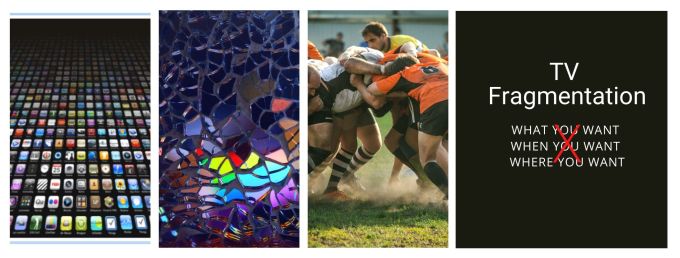
The industry adage of ‘What I Want – When I Want – Where I Want’ still cannot be satisfied. Content owners have fragmented or gone vertical, leaving the consumer foraging for certain content across all manner of locations. The costs are mounting up and the consumer is becoming disheartened.

On a recent weekend, I wanted to watch Wales against Scotland and saw that it was not on my NBC Sports Gold app. I quickly went hunting and could not find the match on any platform that I was subscribed to. How frustrating! Very, very disappointing! Even the pirate sites that I found were asking for money (naturally) so its not an option.

At home I have a Cox subscription (it wasn’t being shown on any channel) … I also have a NBC Sports Gold rugby pass but it didn’t show it, Netflix – don’t do sport – Hulu – don’t do sport – HBO Max – don’t do sport … then there is DAZN purported to be the Netflix of sports – don’t do International rugby in the USA – Rugby Pass – geo-blocked … #WTF what’s the point? I am feeling hard done by and frustrated. I am tempted towards piracy – it is cheap and is available. Doesn’t the industry understand that they have an issue?

I’ll keep up my hopes of getting – What I Want -When I Want – Where I Want, but I don’t think that will be for quite some time, if ever!

New Book Now Available


Social Media Psychobabble – Stop Feeding the Beast is now available to order.

It can be bought through www.socialmediapsychobabble.com, which takes you to Amazon UK, Germany and USA.


PLEASE STOP PREDICTING THE DEMISE OF TRADITIONAL TV – IT’S BORING!


tvoldHere we go again! … Old TV versus New TV … Because you can open a TV channel on the Internet you can make money and therefore traditional TV is dead!  Since the AWS announcement certain ‘TV Experts’ have declared it so.  There are so few people in the world that can predict the future (i.e. ZERO) but there are people who can look at the past and the present and then extrapolate ideas of how things MIGHT work out: Seldom are any of them right.

By the way, notwithstanding the progress of video content over the Internet (OTT) there is an abundance of closures:

Fullscreen, Afrostream, Sportflix, Go90, Vessel, SeeSo, Redbox Instant, Xbox Entertainment Studios, Samsung Video & Media Hub, Stickam, Flickr Video, Metacafe, Justin.tv, Veoh, Blip.tv, vidiLife

Can you make money in OTT Shelly Palmer? – You make it sound so easy … (Why not try starting a video business and see how it goes).  It’s OK here is someone who has done it: This is a real OTT story Afrostream Closes – This is an amazing insight into the $$$$$$$ that are needed to survive and it openly describes the full impact of what it takes.

If  a 2% Churn rate is an issue for a Pay-TV provider why is the following statistic not an issue to the on-line video businesses?

“OTT Churn Rates Pass 50%”

We do not know how this industry will pan out. Fragmentation, Churn, Net Neutrality, Content Investment and the Pay-TV businesses not just rolling over and dying is some, but not all of the things to be considered when predicting the future of TV … And touting Statistics does not make you an expert…

Social Media Bitchiness


There is a sickness in the world and it is called Social Media … Actually Social Media is OK, it is the nasty folk that hide behind it which is the real problem.  Even something as trite as trying to get a book publisher turned into a recent bitch fest.

Austin Macauley is a Publishing House that still accepts unsolicited manuscripts so naively I sent something in, thinking why not? The book I have written is a little quirky and all about Social Media; All the BAD that it has created. I did not expect a positive response from AM but one (naively) always hopes for a positive reaction.  Even a positive-negative response is a step in the right direction for any author.  Months on and a follow-up email to them went without response.  For some reason (a sixth sense) I got a little suspicious and thought maybe this is a scam…p.s. the book (if it ever publishes) will explain my paranoia.

Looking around on-line I came across this: The Writers Workshop and an article by Harry Bingham who was questioning the methods of AM the Publisher…intimating that they are in reality a Vanity Publishers as they ask you to pay to have your book published.

Having tweeted this story on my Twitter account AM’s Social Media Manager decided they didn’t like what they read and responded immediately.  Their SM dashboard had obviously flashed up a signal that criticism was being levied at them. I was slightly incensed that they were rapid enough to write to me on Social Media but had not responded to my other more inquisitive correspondence about my manuscript via their website.

I sensed that the Harry Bingham story and my subsequent Tweet had hit a raw nerve … and suddenly this came through: … ‘we sent you an email but it didn’t get through.’ Ermmm! Email that does not get through … not in 2017 to a very simple address … I was not convinced!  Then I suddenly received, ‘with no problem’, the standard blah blah blah your book does not meet the criteria of our reading list etc. No thank you! Fair enough I thought!

Meanwhile the Social Media conversation was ongoing.  In the thread the following was said:

@AustinMacauley It took Social Media accusations of skulduggery to get a response – I need to burn the book hahaha! Vanity be thy name!

This was swiftly followed by a BITCHY message that is glowing in sarcasm and has ‘fuck-you’s’ all over it.

@ASChaigneau We are very sorry that our email did not get through the first time round, but are very glad that you’ve seen it now.

Oooooohhhhh How beautifully crafted is that Tweet – English wordsmithery at its best. Worthy of a Book Publisher hahaha n’est ce pa?  How subtle is that ‘go fuck yourself’ message. #LOL (Normally water of a duck’s back but I will not let this one go. It is perfect for the next book…to be continued)

THE HOW-TO GENRE IS THE BIGGEST ‘CON’ IN ‘CON’TENT MARKETING


I followed a Twitter link on a HOW-TO subject that interested me for the simple fact I have to write case-studies … I naturally fell upon this typical ‘Content Marketing’ nonsense advice.

Desperately disappointing and so typical of the WWW repository of nothingness!

How to write a credible case study

At XXXX we have written hundreds of case studies for clients like Microsoft, HP and LinkedIn. Based on our process and experience, here are ten tips to help you write better case studies:

  • Do your groundwork.  NO SHIT SHERLOCK! I AM NOT GOING TO WRITE ABOUT SOMETHING FOR A CLIENT THAT I KNOW NOTHING ABOUT AND THEY EMPLOYED ME!!! Understand the product or service being sold, and research the companies on both sides of the deal. This can be as simple as reading the ‘About Us’ section on a company website, or their company news page. You need some context for the deal you’re writing about.
  • Get some background. I AM CONFUSED HERE ABOUT OBVIOUS QUESTIONS! Try to get hold of the person who was on the ground and made the deal, and get them to tell you what happened. Get some background so when you speak to the client you aren’t wasting their time with obvious questions.
  • Interview the right person. WELL I NEVER! … WHAT? GET HOLD OF PEOPLE WHO ACTUALLY WORKED ON THE DEAL! … The real story will come from the people actually involved in procurement, implementation and customer relations. Avoid interviewing marketing or PR people, as they will only tell you a repackaged story, which will sound hollow when you write it up. You want the real customer, preferably a champion of your product.
  • Find the story. A USE CASE IS A STORY OTHERWISE THERE IS NO STORY! This is the crux of the case study. There has to be a story: a struggle before, a journey to improve, and a benefit in the present. This doesn’t always mean profits: it might be improved employee retention, saved time or a new business model. The focus is on what matters most to the person you interview. And make sure you tell the real story – no inflated figures.
  • Create a template. NOT THE CREATE A TEMPLATE ADVICE – WHOOPEE DOO DAH! Once you have your basic story you can build a structure. Most case studies fall into company biography, challenge, process and benefits. Structures are there to emphasise the story, not shackle it though. Tweak it to the story, and give yourself four or five subheadings.
  • Categorise your transcript. GO THROUGH YOUR NOTES… ARGHHH! OH YES … IT BECOMES AUTOMATIC DOESN’T IT? Take your interview notes and go through them, assigning each part to one of your subheadings. You should end up with three to five key points for each section. The more you write, the more automatic this step will become.  The flow of the story will be obvious as you do the interview.
  • Find your key quotes. WHAT THE EFFS A FRANKENQUOTE??? Never use frankenquotes in a case study; people can spot them a mile off. It is best to use short, snappy quotes, dotted throughout the case study that underline or explain one of your bullet points. Let your interviewee’s personality shine through.
  • Flesh it out. OH MY – NOW WRITE IT ALL DOWN????? You have a structure, bullet points and key quotes, which means the writing part should now flow easily. If it doesn’t, you haven’t got to the real heart of the story: go back and reassess the structure to make sure you are emphasising the right points.
  • Clean it up. EDITING BABY EDITING_IMPORTANT STEP N’EST CE PAS! … Don’t use too many marketing phrases or clichéd product explanations – keep it human, but make sure you are referring to products correctly, and types of implementation or acquisition in the right way. Keep the story accurate. And be sure to include specifics.
  • Cut your copy. WHAT RANDOMLY SAYING ANYTHING A MILLION TIMES IS NOT GOOD???? MAKE IT VITAL HA! HA! HA! – SERIOUSLY PEOPLE!!!! A case study shouldn’t be longer than 500-750 words. Any more and people just won’t read it. Cut out repetition, shorten quotes, and make sure everything you write is vital to the story.

A Short Play Called ‘The Death of TV’


Setting the scene: The evening light is dimming.  It’s 8pm and the children are snuggled down in bed and the husband says,  “Dinner is almost ready honey, can you find us something to watch on TV?” …


Picking up the remote the wife switches on the TV …

“I don’t know darling!” “Why not honey?”  “Because there is only a bunch of icons on the TV and I cannot see any TV shows, that guide thingy we used to have, it’s gone darling!”  “Gone! Why would they do that honey, it was very convenient.”  “I heard that you are supposed to know what you want to watch darling, you just ask for it now.”  “Really honey, OK!”  “Are there more programmes like that documentary on South Africa we saw the other night?”  “Maybe darling, what was the programme called?” … “Ermm, what channel was it on?”  “I cannot remember darling.” “Neither can I honey.” “Oh!” “Now what shall we do?” … “Ask the TV honey its got that voice thingy activated.”  …

Wife fiddles with remote control – pushes button …

“TV,  Can you find me any travel programmes about South Africa, but not about South Africa as we have seen that, what about somewhere else please.”

Screen icon turns … searching … searching … searching … TV replies

“Can you be more specific, I have 24,000 programmes on South Africa and 30,000 programmes not on South Africa and I have several shows called Somewhere Else.”  “I have them in English, Greek, Spanish, Arabic, French, Portuguese, Polish, German and 25 other languages, what do you want me to do?”

8.45pm: “Have you found anything honey?” “No darling, I’m afraid not … its not that instant anymore.”  “Shall I put the radio on honey?”

The End.