Another InternetTV Alliance – As in Europe it is Heavily Supported by Equipment Manufacturers


According to the DigiTimes (http://www.digitimes.com/news/a20091201PD202.html)  The Taiwanese Electrical and Electronic Manufacturers’ Association (TEEMA) and the government-sponsored Taiwan Digital Television Committee (DTVC), all under the auspices of the Ministry of Economic Affairs (MOEA), have announced the formation of an Internet TV Alliance  aiming to tap into the Internet TV service and hardware market in China.

Members of the alliance include makers of LCD TVs, IP (Internet protocol) STBs (set-top boxes), network/communication equipment as well as Chunghwa Telecom (IPTV service), TV broadcasters such as Taiwan Television Enterprise and digital content providers, DTVC indicated…

Internet TV – A Desperate Cry For Help …. —- ….


Companies are so intently focused on the potential new-frontier of InternetTV that they are being blinded by the realities and weaknesses of the delivery system.    The   average ISP does not stay connected 24/7 and the speeds that can be delivered vary enormously.  The connectivity of devices to the ADSL modem is also a complex affair.  There are subscriptions to pay and content streaming restrictions in some cases.  It is a much more awkward technology than say a Digital Terrestrial STB or Satellite Dish set-up.  Cable operators have a pipe to the home and handle the system to maximise delivery and ensure quality of service….The Internet has multiple owners and various stages of the value chain and that makes it inherently weak.

At the weekend whilst on a jaunt in London I learnt that ChannelBee the InternetTV Channel started by Ex Sky Soccer AM host Tim Lovejoy and Simon Fuller (Pop idol etc.) has ceased operations as of the 20th of November 2009.  Ironically Fuller stated this less than a year before : “Everyone is excited to see what Tim and his former Soccer AM team will do next. Channel Bee will surpass their expectations and change the face of what can be achieved online”.

It is plainly clear what can be achieved TECHNICALLY on-line in terms of video and audio and yes you can create “On-line TV Channels”,  HOWEVER can you create a following, make them connect, pay subs and generally attract advertising and all the other aspects that make a BUSINESS run?

I also read that Sony is calling their new attack on this brave new world “Sony Online Systems” (SOS) and therefore ladies and gentleman it finally comes to pass that the marketeers  have finally come clean;  SOS =  “Save our Souls” –  Which if I remember my days in the military as a radio engineer it is an acronym that is “A Desperate Cry for Help When the Ship is Sinking”…. —- ….

The Hype and the Reality need to be in synch for this to be a credible move for Television.  No we will not stop the tidal wave towards the Internet as a delivery mechanism for Television – HOWEVER it will create many more victims along the way.


Another OTT VOD Service hits the Internet – Proprietary style


‘TF1 launches MyTF1 VoD service on Bbox’ Nov 26, 2009 (DMEUROPE via COMTEX) — French broadcaster TF1 has launched the MyTF1 VoD and catch-up TV service exclusively over Bouygues Telecom’s Bbox IPTV offering. The channel is in talks with other ISPs and could result in its extension to other operators before the World Cup next year. MyTF1 offers access to TF1 shows after they air as well as a video rental service with a catalogue of over 3,000 titles. Bbox had around 170,000 subscribers at the end of September. Bouygues Telecom and TF1 are both subsidiaries of French conglomerate Bouygues.

http://www.tmcnet.com/usubmit/2009/11/26/4503001.htm

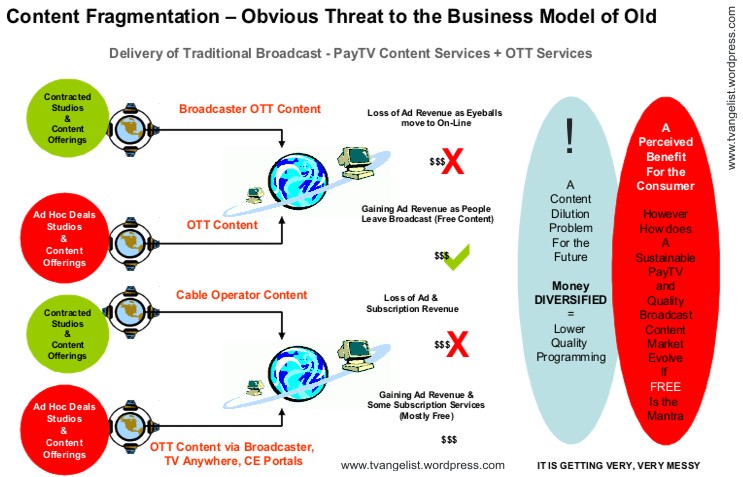
OTT Reached Fever Pitch – Dilution of Content = Dilution of Revenue


With the announcement of access to a VOD Portal via the Sony PS3 as well as various other deals of the same ilk in the market place we now see the news arriving at fever pitch regarding “Over the Top” services available to the general public – But who is that public;  who is that consumer?  Who actually has the time to watch “Linerar TV, PayTV, OTT TV and PVR stored TV” as well as DVD Box sets and Blu-ray disks.  Who on earth can consume so much TV that the Broadcasters think that there is a viable market?   Furthermore what is the business model for the OTT route which appears to cannibalise on the mainstream delivery mechanism.  Is the industry really going down this route so it can actually close down its Terrestrial committments and in the future stream-line the business in terms of cash flow and investment by a full remodelling that offers InternetTV and no other form?   Has the mathematics been done in terms of TVHH coverage which clearly DTT can beat hands down as a distribution mechanism?   Aren’t the advertisers who are supposed to be the funders of the DTT Broadcasters asking about the dilution of their target audience?  I ask this as most people I know in my private life (across several countries and continents) do not have the time to watch catch-up TV or OTT services.  Most of them have a job and go to an office where they spend all day doing email (as is the modern malaise).   Then on return to the family abode they actually meet their family and have family time and an evening meal before being able to relax.  A lot go to some sort of sport training and some even play pool and darts in competitions which eats into the availbale TV hours that are on offer.

I know that I keep repeating this but it is exactly how the Music industry saw the business (rush to go on-line) and it was badly damaged at the time.  Granted Broadband speeds are different today but the business model is not about the speed and quality of the product delivery – MP3 is a testament to that…It is about monetizing the content.  The music industry business model now favours the “connected” and I can assure you that this is a smaller percentage than you can ever reach via the “airwaves” in Radio &  TV.


Reference Implementations – History Repeating Itself


Question:  How can you introduce a “Reference Implementation” into a middleware market when there are already millions of STBs running good quality implementations of that middleware…then claim that the RI (that runs on a PC) is the “Gold Standard” and has to be adhered to for future devices that run on your network?  You can if you want to copy European Middleware business – A replication of what an MHP Organisation did all those years ago (Remember the IRT Reference Implementation) and it delayed the market by 2 years or more as people learnt that the RI was not worth the code it was written in and would never be deployable…The “Gold Standard” was that middleware already deployed.   Debugged, market tried and tested.  Real world network implementation not lab theory is what matters in the TV Software business.

Why Does the UK Think it Governs the Digital TV Landscape?


Many people in the TV world seem to think that the UK, which is most certainly a well developed Digital TV landscape,  is somehow important in the rest of Europe nay rest of the World and those people are especially concerned with what the BBC thinks or does in technology…Hybrid is a Business issue as well as a Technical issue so that makes it more of a challenge.   Is the technical part of the Canvas project of major concern to the rest of EMEA or just a curiosity in this complex world of Internet and Broadcasting…Methinks a curiosity as someone has to look at this rather perplexing overly developed technical portfolio TV is faced with.  So let’s look at the BUSINESS problem highlighted by the BBC themselves – The BBC delivers “Free To Air” Content (created with money derived from a License Fee)…So in a multi facted, complex multi digital landscape theirs is an issue of cost of re-purposing  and re-authoring of Content and any associated Applications in this new world.  They themselves complained about more than 14 different codecs and multi DRM to deal with…that was their gripe and the reason for the intiative: To reduce Cost.  The BUSINESS model is also an issue and it is as Trender research puts it based on a principle of FREE and that is upsetting PayTV Operators in the UK market as other content is leaking onto the internet and is Free.   This was the Music industries issue and the Publishers issue…now its Videos turn.  A Standard cannot solve that it can only aid greater, wider distribution of the same FREE content.

So the Canvas we all talk about goes towards trying to solve a particular TECHNICAL problem for the BBC however when it comes to technical matters and choosing 1 Video Codec and 1 DRM, 1 middleware, 1 GUI, in what SD or HD with 1 Font etc. the initiative may stall even die…anyone who has any Standards work experience will know that Companies who are stake-holders will try to have their technology included.  Choosing a path or direction and technology is not a Standard its a business choice.  And I keep saying  OTT Content is only VOD so is it really feasible to even think we can Standardise VOD in a Retail Horizontal market-place where OTA broadcasters operate?  On a country by country basis Europe is full of its own digital islands and will need its own flavour of Canvas. e.g.

  • The French certainly do not think Canvas matters all that much…they are doing their own OTT joint venture.  France is as equally large in terms of TVHH (Television Households) and has many other countries bordering it and other territories that are still dependent on the French language programming which could make it actually a greater TV power than the UK.   No arguments please…just a hypothesis.  Spain would argue this too.  So how will the more central European countries manage – will we finally see one Europe because of  OTT TV?

In the USA a large Digital Island – TV Everywhere:  A finger in the Dyke of “Content Leakage” – The Content Providers are doing deals in a shotgun distribution fashion and harming the core business as they do it (FREE CONTENT IS ATTRACTIVE TO CONSUMERS).  Now very much “Content is King” but they never knew it was going to be such so Regal…TV Everywhere is at least looking at it in a PayTV model manner with subscription.  An extension of the Cable Operator boundary….This does NOT solve the OTT FREE CONTENT BUSINESS MODEL ISSUE.

Then their is another TECHNICAL solution to Hybrid a la CE manufacturers and STB manufacturers in Retail under HbbTV – One CE manufacturer and backer of HbbTV recently announced in a public convention that the Broadcasters will have to compete with them for Content (They are all doing deals to get what the Broadcasters get)….So the CE manufacturer sees only a WEBTV Portal and will (damn it) have to put a DTT tuner in the box because the Broadband Cable might not be connected and they cannot have a TV on the market that cannot capture TV signals now can they.   So they look at it from an Internet perspective with Browser back to delivery but have not looked at standardising the OTT content aspect as that will be left to each CE manufacturer to choose a partner…HbbTV has not concerned themselves with the real issues of Multi Codecs and DRM ( or how do you upgrade your software in your TV?) so the Content Provider (a la BBC) problem is not solved…Fragmantaion is increased at Equipment level.   HbbTV is really a new broadcast middleware as the Internet part is NOT mandatory thus if there is no Broadband connected then there is NO video or interactive services available other then OTA…If the Internet is so key to the business model then it would/should be made compulsory…however in a Retail Market you cannot force the customer to connect the return channel/broadband pipe just ask Sky!

So all in all this is a very complicated situation:  I feel that Viviane Reding and Neely Croes will step in soon and start to look at legislation and competition issues surrounding this TV Problem.  Then we will see the fun begin as the Stake-Holder Lobbyists creak into action…

Vive la Revolution.

Comcast calls for content sector to fight OTT


This article in http://www.advanced-television.com/2009/oct26_oct30.htm#t1 is very much part of the discussion that we are all having and finally someone has spoken out  – someone who sees it potentially damaging their business.

Comcast calls for content sector to fight OTT

Comcast’s chief operating officer, Steve Burke, has issued a warning to content providers who sit by idly and complain about online viewing without doing something to change the TV business model. “An entire generation is growing up, if we don’t figure out how to change that behaviour so it respects copyright and subscription revenue on the part of distributors, we’re going to wake up and see cord cutting.”

He said the current OnDemand Online trial – offering viewers access to cable channel shows in exchange for identifying themselves as subscribers – was not an effort to “change the advertising model or get a minute back from content providers,” rather it is a way to “get in front of the biggest social movement I’ve ever seen. Online video consumption is off the charts.”

Previously cable operators have played down the extent of cord cutting and some analysts say they’ve seen little real evidence of a supposed phenomenon that has subscribers cancelling their cable subscription to watch online for free.

“Some people’s business models are going in the wrong direction,” he said, a likely reference to News Corp, Disney and NBC Universal who are partners in free online video site, Hulu that is considering putting some content behind a pay-wall. “I’ve yet to meet a content provider who doesn’t worry about cord cutting and doesn’t see the wisdom of trying to get ahead of that. Stop talking about how hard it is and start figuring it out,” he said.

Meanwhile, News Corp deputy chairman Chase Carey has added his voice to calls for a move to charges being levied for internet services – in this case for the Hulu online video-on-demand joint venture between NBC, News Corp and Disney.

Carey told the Broadcasting & Cable OnScreen conference in New York that the advertising-supported model for Hulu was not sustainable in the long term. He said that the service would require a subscription model as part of its business. He implied a subscription service could be launched as early next year, although Carey said that no fixed date had been set.

UK Broadband Not as “Available” as We All Believe…


j0390568The Daily Telegraph has been discussing the state of UK Broadband and reported on a Which Magazine report  which has come up with some startling results.  The article in the Telegraph on the 22nd October on page 11 had the title of: Broadband Problems Hit Half of All Users:  First of all I am extremely happy that other people apart from myself are upset with their Broadband provider.  In fact in many cases it is the same provider who also has a foothold in the UK market.   And they are a colour that is the national colour of my darling wifes home country of Holland.   This article ties in with a lot of the discussion I am having (with myself in this blog looking at the hit rate) – It is becoming more and more clear that Quality of Service is far far more important than football matches over the Internet.  The biggest issue is repeated an lengthy periods of disconnection and failing equipment.  60% of the people had to contact customer services…and the shocking part of the report is that it states that whilst most of the problems were rectified inside a week; INSIDE A WEEK! That 16% took longer to solve and 8% remain UNRESOLVED.   Now you may have never had a problem with your Broadband provider but I ask you one thing; Have you ever had such outages on your Cable, Satellite or Terrestrial TV Service.  Some might answer YES! However I would imagine that not until you went DIGITAL did this happen.  I am a technologist at heart and a fan of technology having been a Telepringter mechanic in the Royal Air Force working on Creed 7B and NCR thermal printers of yesteryear.  I have lived like many throught the Sinclair Spectrum days and bought a Viglen AT Compatible (Had I have known it was an Alan Sugar Company I might have thought twice) so I know all about this stuff.   MANY PEOPLE DO NOT and that is the point of this story.  We want to bring IPTV and Internet TV and OTT Services to an infrastructure that is NOT READY OR ABLE TO GIVE 100% Service as does the airwaves.  Will you be compnestaed if you cannot get to your Email, Webpages, Blog, Wave, IM, Twitter, Facebook, Telephone, TV, Hybrid, Converged Multimedia services and Burglar Alarm service (yes my alarm is connected via the Broadband system to the control centre…NO YOU WILL NOT because I lost my Broadband Connection for 22 Days last November and I never even got an apology from ORANGE who are featured in the report from Which.

We are also told that only major urban centres benefit from Broadband of any speed.  There is a Daily Telegraph campaign for better Rural Broadband.  The TV Signals are not beset by such boundaries to the point that a large ex patriot community enjoy UK TV whilst outside the UK…If we go Internet TV only the favoured few will actually be able to watch anything and then at an extra cost over and above any TV licenses.